This Is Where It Ends by Marieke Nijkamp
Published: January 5th 2016 by Sourcebooks Fire
Pages: 292

10:00 a.m.
The principal of Opportunity, Alabama's high school finishes her speech, welcoming the entire student body to a new semester and encouraging them to excel and achieve.

10:02 a.m.
The students get up to leave the auditorium for their next class.

10:03
The auditorium doors won't open.

10:05
Someone starts shooting.

Told over the span of 54 harrowing minutes from four different perspectives, terror reigns as one student's calculated revenge turns into the ultimate game of survival.
“And I know the auditorium may be big enough to hold a thousand students, but it's too small to hide just one.”
Well, it sure comes as a surprise that This Is Where It Ends took a lot longer to read than I intended. Usually when one takes so long to read, it was a bit too easy to set the book down. There were no long reading sessions, nor did I sit on the edge of my chair. What I first expected to be a thrill ride with lots of emotion, left me feeling numb.

I wanted to love this book more than anything else. The amazing premise set my hopes high, only to be disappointed afterwards. School shootings are more current than ever, with Columbine and Sandy Hook as most-known. It's intriguing and controversial, but lured me in very easily. Although it started off with a bang (pun intended), this book turned so shallow so quickly. Nijkamp failed miserably in portraying a realistic school shooting. I have never witnessed one, nor do I have any experience with it, but the whole situation was kind of hard to believe. There was so much Black-and-White Thinking, it completely left no depth nor complexity for something so emotionally gripping. No shooter is born evil, or is all just evil. There is much more behind a person than being evil, and the shooter was in no way portrayed like that. Readers get the impression that he's a monster and there is nothing to do to save him. All it did, was causing cringe-worthy scenes where a significant other tried to convince the shooter that he can be changed.

At first the writing style appealed to me. As soon as the book started, the tension was building up at a steady pace. In those moments I clutched the book and flew through the pages. Every chapter was only a few minutes long, so naturally there were a lot of thinking instead of action. The tension was palpable, yet after a while, it was inevitable to get bored. The outstretched chapters began to work at my disadvantage, as the action was kind of overwhelmed by mental processes, flashbacks, unnecessary tweets and blog posts. The necessary tension began to fade away, and so did my attention span. It was sad that suddenly I could put the book down very easily, and not bother what could happen next.

Most might already know that the author is a member of several groups that promote diversity in young-adult books. Therefore it doesn't come as a surprise that This Is Where It Ends also counts quite a few diverse characters, which I really appreciated. Every author who adds diversity into their books, is one to applaud. To move on to the several POVs: I first feared that there were too much. An author's inability to write in different voices occurs more often than not, which mostly causes my inability to distinguish all the characters. In the beginning I had trouble figuring out all the relationships and connections, and separating the backgrounds, but it didn't last very long. The more I progressed with the book, the more I started to appreciate all these connections between the characters and the shooter. It just shows how small a school can be at times.

I still don't know how I feel exactly about This Is Where It Ends. Although it contained several aspects I enjoyed, the more I read, the more my disappointment grew. In all honesty, this could have been so much better, if not for the predictability, the Black-and-White Thinking and the writing style.

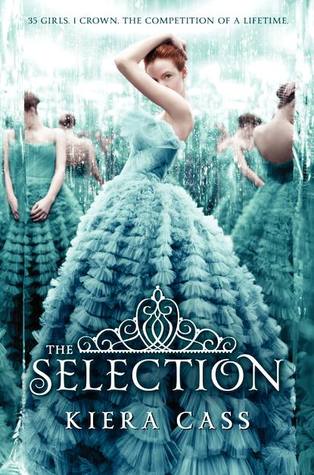
10507293The Selection (The Selection, #1) by Keira Cass
Published: April 24th 2012 by HarperTeen
Pages: 336

For thirty-five girls, the Selection is the chance of a lifetime. The opportunity to escape the life laid out for them since birth. To be swept up in a world of glittering gowns and priceless jewels. To live in a palace and compete for the heart of gorgeous Prince Maxon.

But for America Singer, being Selected is a nightmare. It means turning her back on her secret love with Aspen, who is a caste below her. Leaving her home to enter a fierce competition for a crown she doesn't want. Living in a palace that is constantly threatened by violent rebel attacks.

Then America meets Prince Maxon. Gradually, she starts to question all the plans she's made for herself—and realizes that the life she's always dreamed of may not compare to a future she never imagined.
“True love is usually the most inconvenient kind.”
Actual rating: 3.5 stars

With the book's release date going all the way back to 2012, I cannot deny that I jumped on this boat way too late. I already knew too much before going into reading, including the final outcome and the entire world building. I gathered that The Selection is a book you either love or hate, but it did not turn out to be like that at all. Maybe I'm just that special snowflake, yet despite my prejudices and eventually my issues, I actually quite enjoyed it.

Starting off: the predictability of the plot. Of course, I already knew a lot of the world building upon going into this book, but the plot was mainly unknown territory. Unfortunately, I foresaw so much that happened without having to have a psychic ability.  It was clear from the start who would get chosen, and what would happen next. When something rather unpredictable did happen, I mostly just sighed because I should have seen it coming. However, the way things ended could create a very interesting plot to follow. I certainly hope Cass can grant my little wish for the books to come.

As far as the predictability goes, so does my negativity about the story. The Selection's plot is surprisingly unique and more original than your average dystopian book. Think of The Hunger Games, Divergent, Legend, Delirum, and so on. They all have one thing in common: a girl who stands up to an evil and oppressing regime. Usually seen from the point of view of the rebels, the series is a journey to start a rebellion. That is what I absolutely loved about this book. Of course, the rebels are palpable and the world isn't something I would want to live in, but it didn't seem to fit into this category. We barely saw anything of the king, nor extreme poverty, so the regime itself did not feel as bad and oppressive. The most specific reason, however, is because the protagonist does not stand with the rebels and believes in the caste system. It created a whole new look on rebels and their actions, as they are now seen as 'the bad guys'. I honestly cannot wait to see what they'll bring.

The caste system itself was by far my favourite aspect of the world building. I for one loved how there was a subtle inspiration of India's caste system. It showed that these kind of things could still happen today or in the near future, which is quite terrifying. The thought that one innate feature could determine your whole life is intriguing, which also played out very nicely in The Selection. A large part of Illéa's population seems to be okay with the whole caste system, and believe that it is their duty and destiny to do what they're supposed to do. That's why the caste system also had a lot of impact on the choices made throughout the book. I liked how believable it sometimes was, and it definitely sparked my interest to keep on reading.

Moving onto the world building, there's no denying that the author hasn't outdone herself. The book has been pitched as 'The Hunger Games meets The Bachelor', and I cannot but agree. We may have seen certain aspects that have been done before, yet there was so much to discover than a simple competition. I am quite the sucker for kingdoms, kings and queens, princes and princesses, etc. It's more than logic that I would therefore love the setting and overall tone of the story. It's girly and light read, with some serious topics here and there.

I feel like I only have one thing to say when it comes to the characters: America Singer. Ladies and gentleman, meet your average Mary Sue who has it all, including a silly name. She didn't frustrate me as much as I thought she would, though it was laughable at times. The examples are endless, but especially the trying of not to come across as perfect. She's a Five, a lower caste, but she knows exactly how to behave as a One. She's constantly saying how flawed she is, but there's no evidence that actually proofs it. She's not all bad either: I did secretly love how she had a strong opinion and clearly did not want to lead a life inside the palace's walls.

The romance itself was overwhelmed by the love triangle. Thanks to all the hype (and spoilers) surrounding this book, I already knew about the ménage à trois. It didn't stop me from being excited and devouring it all. Even though I know the outcome, I couldn't help but root for my favourite couple: Maxerica. More does not to be said.

In a nutshell, The Selection was a fun little ride to experience. I did came across some issues along the way such as predictability and a Mary Sue, but I tend to forgive too easily. Especially because of the original world, which really set it apart from other books in the dystopian genre. Hopefully, the rest of the series will be as fun to read as this book was for me.

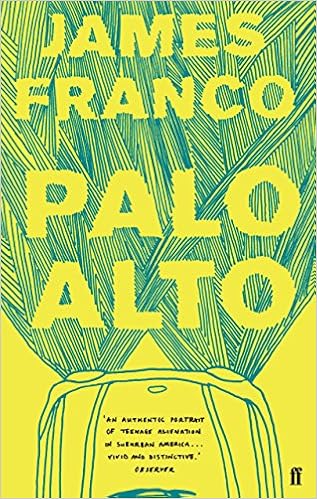
Currently readingPalo Alto by James Franco
Published:  August 2011 by Faber and Faber
Pages: 224

Palo Alto is the debut of a powerful new literary voice. Written with an immediacy and sense of place Palo Alto traces the lives of an extended group of teenagers as they experiment with vices of all kinds, struggle with their families and one another, and succumb to self-destructive, often heartless nihilism. Franco presents his characters in all their raw humanity, while at the same time providing insight into the teenage mind.

In the classic American tradition of story-cycles such as Sherwood Anderson's Winesburg, Ohio, Palo Alto presents a stark, vivid, disturbing, but, above all, compassionate portrait of lives on the rough fringes of youth.
“Everyone pretends to be normal and be your best friend, but underneath, everyone is living some other life you don't know about, and if only we had a camera on us at all times, we could go and watch each other's tapes and find out what each of us was really like.”
When it comes to short stories, I am always a bit hesitant. It could always go in so many directions, because you cannot really expect what you're going to read. After having read the reviews and the blurb on the back, Palo Alto is supposedly a book about American teenagers living their suburban lives. Having lent the book from someone, he told me to not have very high expectations. I am glad I listened, because this book can be described with three key words: dry, vague and weird.

To break down every single story would not be possible, simply because most of them did not have a steady plot. There were some where nothing really happened, and were just fragments taken out of normal teenage lives. It was safe to say that this was the only aspect I liked, as most teenagers are not chosen ones or go on a magical and life-changing adventure. However, I felt like I had read all of them by the time I got to the second half of the book. Generally the same themes are handled in all of the stories, and after a while it just seemed like they kept getting recycled. Despite all this, I did have my favourites, such as American History and Lockheed.

I liked how Franco tried to connect his stories, however with the emphasis on tried. A handful of characters also appeared in other stories, but there was no real connection. In fact, it was more like a familiar name appeared every now and then. A nice try, but after a few stories I wasn't paying attention anymore.

If I had to sum up my biggest Palo Alto pet peeve, I would go straight for Franco's writing. So yes, he is a director and a screenwriter, but this is still his debut novel. As someone who loves flowing writing with some lyrical hints here and there, I did not love this. This book is a collection of short, dry sentences which lacks one of the most important writing rules: show, don't tell. I believe I cannot count on both hands how many times I read: "He was excited", "She was angry", etc. It came across so dry that it made both the stories and the characters very superficial.

The characters are one by one quite flat and one-dimensional. Although Franco is trying to portray the lives of normal American teenagers, I got the feeling they were stereotypical delinquents. The black gangs, the nerd, the slut, the asshole, they were all there. Fortunately, it didn't bother me as much as I thought it would.

In a nutshell: Franco's short stories about American teenage lives wasn't exactly what I pictured it to be. After my encouter with superficial and weird stories, bad writing and one-dimensional characters, I would rather go back to my chosen ones and magical adventures.

Next PostNewer Posts Previous PostOlder Posts Home